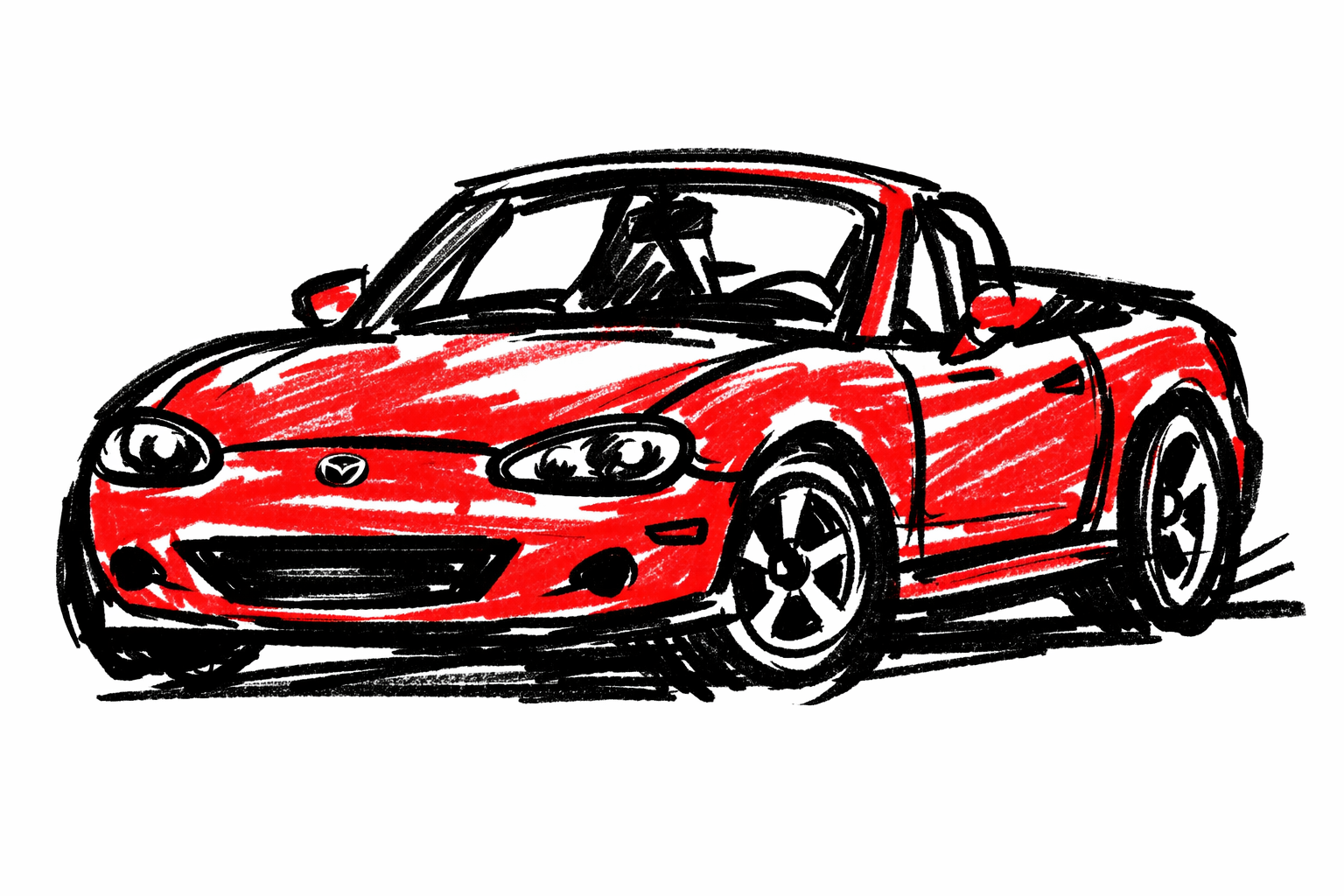
Before You Start / Safety
- Car on flat ground, wheels chocked.
- If lifting, use stands before applying pry force.
- Keep hands clear of pinch points around control arms and subframe.
Required Tools
- Jack + axle stands
- Flashlight
- Pry bar
- Marker/chalk (mark suspect bushings)
- Gloves and eye protection
Required Parts / Fluids
- None for inspection-only work
- If replacement needed: location-specific bushings/arms + new alignment hardware as required
NB bushing layout (inspection map)
Inspect these common wear locations:
- Front upper control-arm inner bushings
- Front lower control-arm inner bushings
- Rear upper control-arm inner bushings
- Rear lower control-arm inner bushings
- Sway-bar D-bushings and end-link bushings
On older NB cars, rear lower/control-arm bushings often show age cracking first.
Step-by-Step Procedure
1) Baseline symptoms before lifting
Record:
- clunk over bumps,
- vague rear tracking,
- steering delay on turn-in,
- uneven tire wear without obvious pressure error.
2) Visual crack/separation check
Use light and inspect each bushing for:
- radial cracks through rubber,
- rubber separating from outer shell,
- inner sleeve offset/“walking,”
- missing chunks or torn lips,
- rust trails at sleeve interface.
Compare left vs right at same location. Asymmetry is often a stronger indicator than age cracks alone.
3) Pry-bar movement check
Apply controlled leverage near arm/bushing housing. Watch the inner sleeve relative to outer shell:
- normal: small elastic deflection, returns to center,
- suspect: excessive displacement, delayed return,
- failed: sleeve knocks, visible separation, metal-to-metal contact.
4) Sway-bar bushing quick check
Inspect D-bushings and links for compression set, cracks, or grease washout (if greased aftermarket style). These can mimic control-arm bushing noise.
5) Decide selective vs full refresh
- Selective replacement: one or two clearly failed locations, others still healthy.
- Full refresh: multiple aged/cracked bushings, recurring NVH/alignment drift, or labor overlap makes one-time refresh more efficient.
6) Replacement planning rule (important)
For rubber bushings, final tightening must be done at normal ride height to avoid preload/twist at rest. Preloaded rubber bushings fail early and can alter ride height/feel.
7) Alignment rule after disturbance
If control-arm hardware/eccentrics were loosened or removed, schedule professional alignment immediately after reassembly.
Practical material choice (planning)
- OEM-style rubber: quieter, more compliant, lower NVH
- Polyurethane: sharper response, typically more NVH/squeak risk, periodic maintenance may be needed
Choose based on use case (daily comfort vs sharper response).
Verification / Post-service checks
- No clunk on low-speed bump test
- Stable straight-line tracking
- Steering self-centers normally
- Follow-up check for eccentric bolt movement after short shakedown
Sources
- MELLENS — Mazda Miata factory service manual archive (NB suspension reference index). Retrieved 2026-03-01. https://www.mellens.net/mazda/
- BOFI Racing — MX-5/Miata workshop manual index for year-specific NB torque/alignment references. Retrieved 2026-03-01. https://bofiracing.com/blog/mx5-miata-workshop-manuals/
- Miata.net Forum — NB/NA owner discussion on selective vs full control-arm bushing replacement strategy. Retrieved 2026-03-01. https://forum.miata.net/vb/showthread.php?t=683815
- Miata.net Forum — Suspension removal/reassembly notes emphasizing ride-height final tightening to avoid bushing preload. Retrieved 2026-03-01. https://forum.miata.net/vb/showthread.php?t=627815