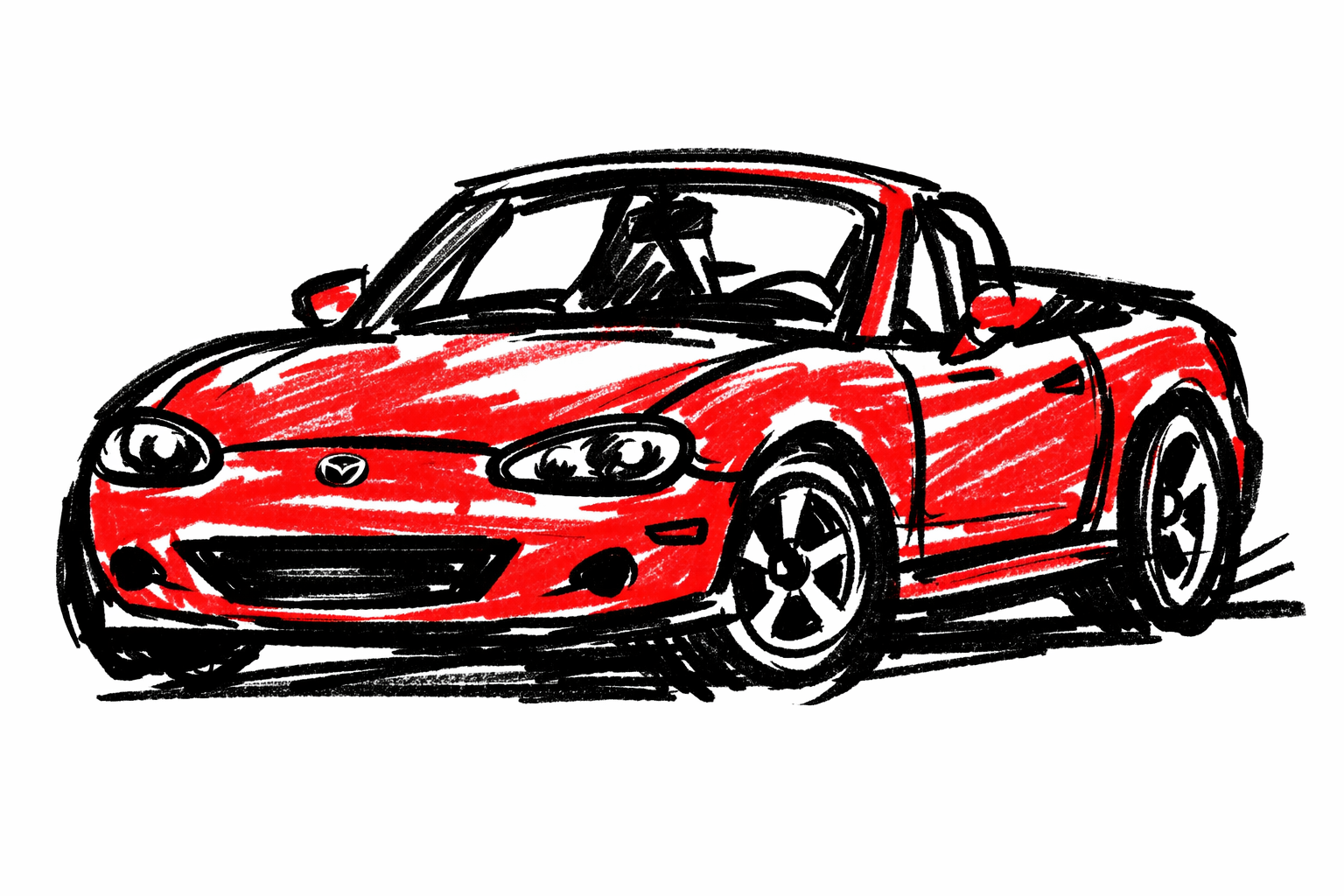
Before You Start / Safety
This guide is for Mazda MX-5 NB (1998-2005, NB1/NB2).
On NB cars, the radiator cap is on the radiator neck, so the side bottle is a recovery/expansion tank. Cracks, bad hose sealing, or a blocked return path can cause repeated low-level complaints.
- Work only on a cold engine.
- Keep coolant off paint, belts, and pets.
- Use a drain pan before pulling any hose.
Required Tools
- Flashlight + inspection mirror
- Small flat screwdriver or clamp pliers
- Basic socket set for bottle bracket hardware
- Drain pan and absorbent rags
- Cooling-system pressure tester (recommended)
Required Parts / Fluids
- Correct NB expansion/recovery tank (OEM-style fit)
- New hose clamps if originals are weak/corroded
- Coolant for refill/top-up (same chemistry already in system)
Where the expansion tank is on NB
Stand at the front of the car with bonnet open:
- The expansion/recovery tank is the translucent plastic bottle next to the radiator at the front corner of engine bay.
- It has MIN/MAX level marks on the side.
- A small overflow/return hose runs between radiator neck/cap area and the tank neck.
Do not confuse it with brake/clutch reservoir near firewall.
Typical failure points to inspect
- Hairline cracks around tank seam and mounting ears
- Cracking at hose nipple/neck where the small hose pushes on
- Hardened hose end that no longer seals under heat cycles
- Cap sealing issue at the tank itself (if fitted)
- Coolant stains that appear only after hot soak
Step-by-Step Procedure
1) Confirm the symptom pattern
Record what happens over 2-3 drives:
- level drops from MAX to below MIN,
- sweet coolant smell after shutdown,
- dried white/pink residue around bottle seam/neck,
- no obvious leak while engine is running.
This pattern often points to small seepage during hot soak.
2) Inspect tank and hose routing cold
- Wipe the tank fully clean first.
- Inspect seams, corners, and bracket contact points with a flashlight.
- Follow the small return hose end-to-end; look for brittle sections and loose clamps.
3) Pressure-test to verify leak source (best practice)
- Pressure-test the cooling system cold using your tester adapter.
- Watch the tank seam/neck and hose joints for bead formation.
- If pressure drops but tank stays dry, continue inspecting radiator, thermostat housing, and hose joints.
4) Replace tank if cracked/warped/leaking
- Drain enough coolant to keep spill controlled when hose is removed.
- Remove hose(s) and mounting fasteners.
- Transfer any rubber isolators/brackets to new tank.
- Install new tank and route hose without kinks.
- Use clamp tension that seals without crushing plastic neck.
5) Refill and bleed correctly
- Refill radiator and set tank to MAX mark (cold).
- Bleed air per your cooling-system procedure.
- After full warm-up and complete cooldown, recheck:
- radiator full,
- tank between MIN and MAX.
Practical capacity/level guidance
- Full NB cooling system is commonly planned as ~6.0 L total.
- Expansion tank itself only carries a small reserve; exact visible level movement between hot and cold is normal.
- Persistent drop below MIN after proper bleed indicates unresolved leak/air issue.
Verification / Post-service checks
- No fresh residue at tank seam/neck after 2-3 heat cycles
- Hose remains dry at both ends
- Coolant level stabilizes in normal MIN-MAX range
- Cabin heat and engine temperature remain stable
Mistakes to avoid
- Replacing bottle without checking hose condition.
- Overtightening clamp on old plastic neck.
- Mixing coolant chemistries during top-up.
- Judging level immediately after hot shutdown instead of next-cold check.
Sources
- BOFI Racing — What Coolant Do I Need For My MX-5? (NB coolant chemistry compatibility and 6 L capacity planning context). Retrieved 2026-03-14. https://bofiracing.com/blog/what-coolant-for-my-mx-5/
- MX5Manual — Engine coolant replacement (cooling-system cap handling and NB coolant-capacity context in manual mirror). Retrieved 2026-03-14. https://www.mx5manual.com/page.html?docid=SM352713
- MELLENS — Mazda Miata Factory Service Manual archive (year/VIN verification for hose routing and part-level details). Retrieved 2026-03-14. https://www.mellens.net/mazda/