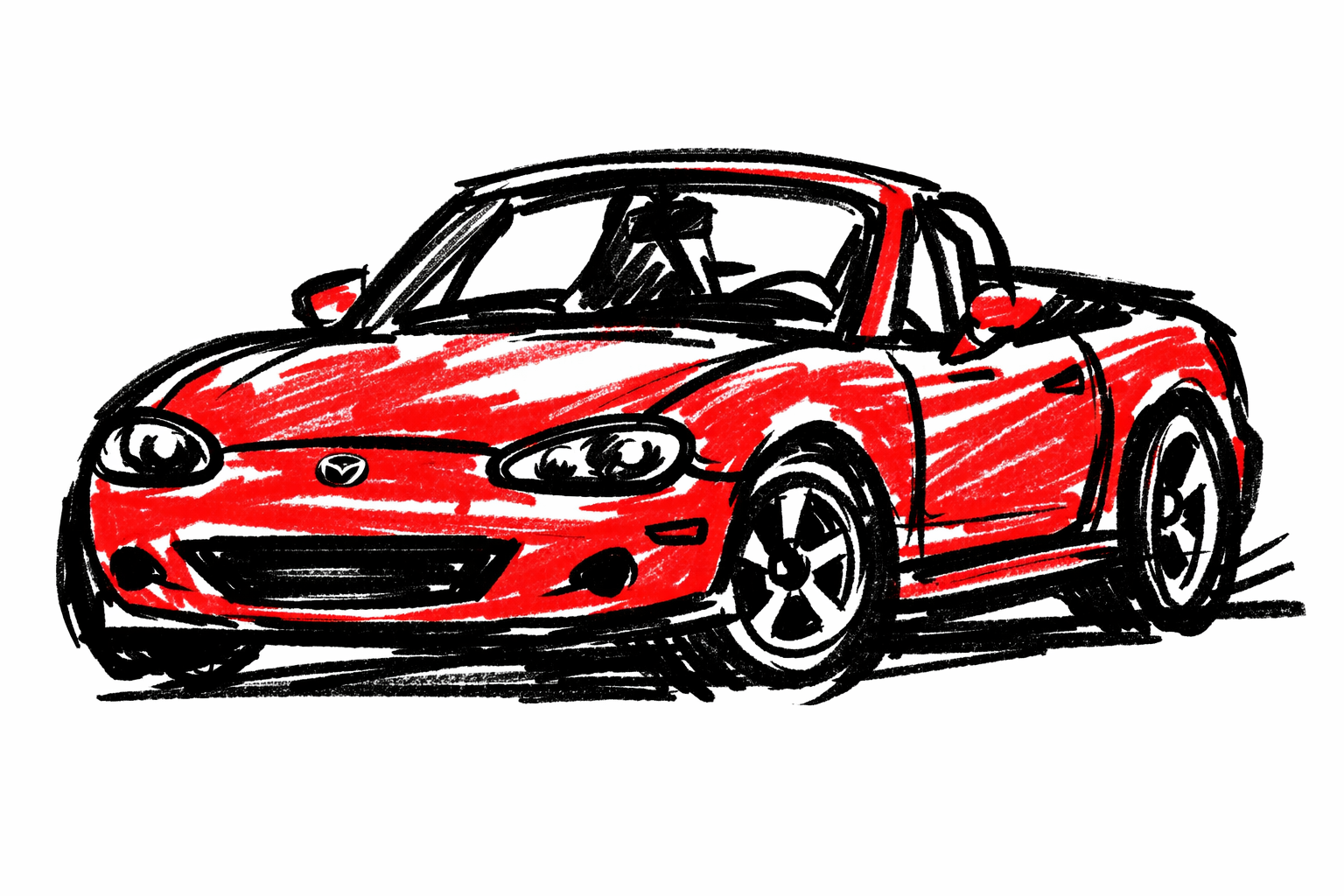
Before You Start / Safety
Never work under an NB supported only by a hydraulic or scissor jack.
- Work only on flat, hard ground.
- Chock wheels before lifting.
- Use stands with capacity above expected axle load.
- If pinch welds are bent/rust-thin, do not load them directly.
Required Tools
- Floor jack (appropriately rated)
- 2 or 4 jack stands (appropriately rated)
- Wheel chocks
- Pinch-weld adapter pad (recommended)
- Flashlight
Required Parts / Fluids
- None
- Optional: sacrificial rubber/wood pad for jack saddle
NB lifting-point orientation (what to use and what to avoid)
Front center jack point (preferred for lifting front axle)
Use the front subframe/crossmember jacking area behind the lower front undertray/radiator zone, not thin sheet-metal edges.
Visual cue:
- robust steel crossmember structure spanning left-right under front of engine,
- clearly thicker than floor rails and pinch seams.
Rear center jack point (preferred for lifting rear axle)
Use the differential housing (center section) as the rear center lift point.
Important:
- load the strong center housing,
- avoid levering on thin cover edges or nearby brackets.
Common stand placement points
After lifting, place stands at reinforced side support points (pinch weld jack notches or robust suspension-support areas, depending condition and adapter availability).
Avoid:
- thin floor rails,
- visibly rust-weakened sill seams,
- random underbody sheet-metal.
Step-by-Step Procedure
1) Pre-lift setup
- Parking brake on.
- Transmission in gear (manual).
- Chock opposite-end wheels.
- Pre-loosen wheel nuts slightly if wheel removal is planned.
2) Confirm point contact before pumping
- Center jack saddle exactly on chosen lift point.
- Verify pad is square to metal (not on edge/corner).
- Raise a few centimeters first and re-check alignment.
If the pad starts walking or tilting, lower immediately and reposition.
3) Lift axle gradually
Lift in short strokes and watch for:
- body shift,
- jack tilt,
- seam deformation.
Do not rush to full height in one go.
4) Place stands and transfer load
- Position stands symmetrically left/right.
- Lower car slowly until weight is fully on stands.
- Keep jack lightly touching as secondary support while verifying placement.
5) Stability verification (mandatory)
Before any under-car work:
- push body firmly at fender/bumper corners,
- confirm no stand rocking/sliding,
- confirm stands stay vertical.
If any movement is seen, re-lift and reset.
6) Rust-aware pinch-weld strategy
If pinch weld is slightly deformed but usable:
- use proper pinch-weld adapter,
- load gradually,
- inspect for new deformation.
If rust perforation/heavy flaking exists:
- avoid that seam,
- choose alternate reinforced support area,
- repair structure before routine seam loading.
Practical mistakes to avoid
- Jacking by thin frame rails/floor panels.
- Using stands with saddle directly crushing seam without adapter.
- Lifting one side high enough to shift car sideways on jack.
- Skipping stability shake test.
Verification / Post-service checks
- Vehicle remains stable with no shifting
- No fresh crush damage at support points
- Stands remain vertical and centered
- Safe crawl/exit path maintained throughout work
Sources
- MELLENS — Mazda Miata Factory Service Manuals (NB year/VIN reference source for official jacking-point diagrams and warnings). Retrieved 2026-03-15. https://www.mellens.net/mazda/
- wikiHow — How to Jack Up a Car: A Safe and Simple Guide (general lifting safety sequence baseline). Retrieved 2026-03-15. https://www.wikihow.com/Jack-Up-a-Car
- wikiHow — How to Use Jack Stands (general stand-placement and stability-check baseline). Retrieved 2026-03-15. https://www.wikihow.com/Use-Jack-Stands
- Reddit r/Miata — jack point pinch weld not reaching center of jack stand (owner-reported fitment issue context for adapter recommendation). Retrieved 2026-03-15. https://www.reddit.com/r/Miata/comments/17t2o5k/.json