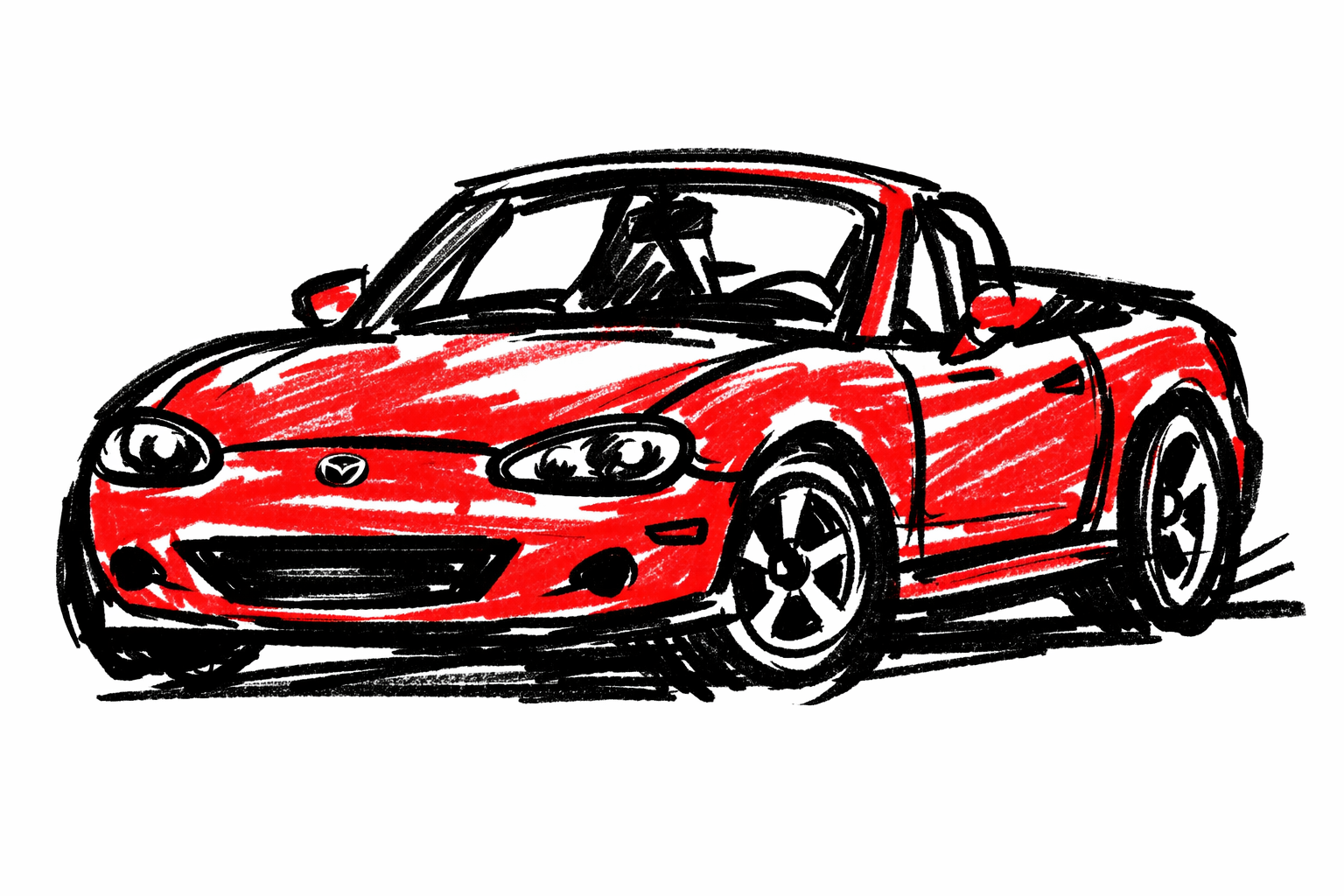
Before You Start / Safety
- Engine must be stone cold (park overnight if possible).
- Ethylene glycol is toxic; use a sealed drain pan and wipe spills immediately.
- Keep coolant away from pets: even small puddles are dangerous.
Required Tools
- 8 L+ drain pan
- Spill-free coolant funnel kit (highly recommended)
- Pliers/screwdriver for hose clamps
- 10 mm socket set
- Nitrile gloves and eye protection
- Distilled water (for flush and dilution)
Required Parts / Fluids
- Coolant chemistry for NB (1998-2005): ethylene-glycol, aluminum-safe. Use one chemistry only in the system.
- System capacity target: approximately 6.0 L (6.2 US qt) total.
- Target freeze/corrosion mix: ~50/50 by volume for most climates.
- Distilled/deionized water only for mixing or flushing.
- Optional while drained: thermostat + gasket, radiator cap.
Practical coolant choices (with what to buy)
- Ready-mix route (simplest):
- Buy 7 L of pre-mixed coolant to cover fill + top-up.
- Concentrate route (better control after water flush):
- Buy 4 L concentrate + 4 L distilled water.
- This lets you compensate for trapped water and still land near 50/50.
Product examples used by MX-5 owners
- Comma Xstream G30 (OAT, long-life)
- Comma Super Coldmaster (traditional ethylene-glycol)
- Mazda FL22 premix only if your cap/manual calls for FL22
BOFI’s MX-5 coolant guide confirms NB total capacity at 6 L and that NA/NB owners commonly use either G30 or Super Coldmaster, but should not mix coolant chemistries.
Model-specific notes (NB1 vs NB2)
- Procedure is the same for NB1 and NB2.
- Real-world drain amount is usually lower than total capacity because coolant remains in block/heater core.
- A simple radiator drain often removes around 3.5-4.5 L, not the full 6.0 L.
Step-by-Step Procedure
1) Locate fill and drain points before opening anything
- Radiator cap location: metal spring-loaded pressure cap on top of the radiator upper tank at the very front of the engine bay (near headlamp side of radiator).
- How it opens: press down and turn counter-clockwise; first detent releases pressure, second detent removes the cap.
- Drain cock location: lower radiator section facing rearward/downward; usually reached from underneath with splash shield access.
- Overflow bottle: translucent plastic expansion bottle beside the radiator.
Only open the radiator cap when fully cold. If the upper hose is still warm/firm, wait longer.
2) Set cabin heater to HOT
Turn HVAC temperature to full hot before draining/refilling. This helps coolant circulate through the heater core during bleeding.
3) Drain old coolant
- Place drain pan under radiator drain cock.
- Remove radiator cap.
- Open drain cock slowly; if blocked/seized, remove lower radiator hose at radiator neck.
- Drain overflow bottle and rinse if contaminated.
4) Flush (if changing type or coolant is dirty)
- Close drain, refill with distilled water.
- Run engine to operating temperature until thermostat opens and upper hose gets hot.
- Shut down, cool fully, drain again.
- Repeat until drained fluid runs clear.
5) Refill with concentration strategy that accounts for trapped water
Because some water remains trapped in the block/heater core after draining:
- Concentrate method (recommended after flush): add about 3.0 L concentrate first.
- Top up with distilled water until coolant sits at the radiator neck.
- Fill overflow bottle to the MAX mark.
Quick rule: if the system holds ~6.0 L total, your final coolant portion should be close to 3.0 L concentrate equivalent.
If you use 50/50 pre-mix immediately after a distilled-water flush, final protection can end up weaker than intended.
6) Bleed air thoroughly
- Install spill-free funnel on radiator neck.
- Start engine and idle; squeeze upper/lower radiator hoses periodically.
- Watch for bubbles; keep funnel level above filler neck.
- When no more large bubbles appear and heater blows consistently hot, fit cap.
7) Road-test and cold re-check
- Drive 10-15 minutes with normal load.
- Let car cool completely and re-check radiator and overflow levels.
- Top off as needed.
Torque Specs / Capacities
- Cooling system total capacity: ~6.0 L (6.2 qt)
- Typical initial drain volume: ~3.5-4.5 L (varies)
- Radiator cap service item: replace if seal is cracked, spring weak, or cap cannot hold pressure.
Verification / Post-service checks
- Stable operating temp in traffic and at cruise
- Cabin heat steady (no intermittent cold bursts)
- No leaks at drain cock, lower hose, thermostat housing, or overflow line
- Overflow level remains stable over 2-3 heat cycles
Sources
- BOFI Racing — What Coolant Do I Need For My MX-5? (NA/NB compatibility discussion, 6 L NB capacity reference, mixing warning). Retrieved 2026-03-12. https://bofiracing.com/blog/what-coolant-for-my-mx-5/
- MX5Manual — Engine Coolant Replacement (Mazda manual text mirror: cap-opening safety wording, ethylene-glycol/aluminum compatibility, and 6.0 L MT / 5.9 L AT capacities where FL22-marked systems apply). Retrieved 2026-03-12. https://www.mx5manual.com/page.html?docid=SM352713
- MELLENS — Mazda Miata Factory Service Manual archive (year-indexed FSM reference source). Retrieved 2026-03-12. https://www.mellens.net/mazda/