Before You Start / Safety
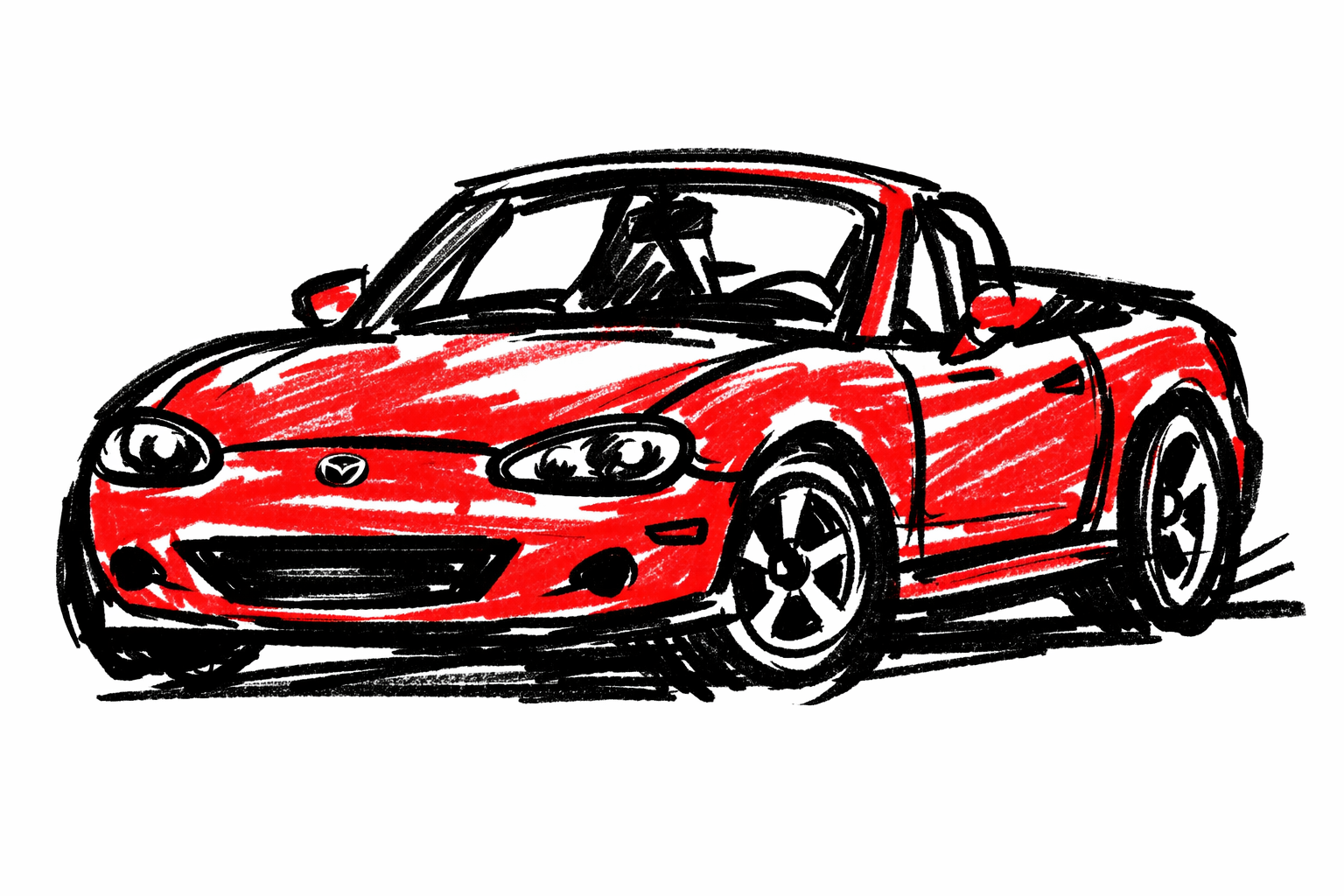
This guide is for Mazda MX-5 NB (1998-2005).
Vibration diagnosis fails when multiple parts are changed at once. Use a repeatable test route and one-change-at-a-time logic.
- Use safe roads and legal speeds.
- Confirm wheel nuts are torqued correctly before testing.
- Stop if vibration becomes severe or steering feels unsafe.
Required Tools
- Tire pressure gauge
- Tread depth gauge
- Flashlight
- Jack + stands
- Dial indicator (optional but useful for runout)
- Access to a quality dynamic balancer (road-force capable preferred)
Step 1 — Characterize the symptom precisely
Record this before touching anything:
- Speed where vibration starts/peaks (example: 85-105 km/h).
- Where it is felt most:
- steering wheel,
- seat/floor,
- whole body.
- Whether braking changes it.
- Whether throttle-on/coast changes it.
Quick interpretation:
- Steering-wheel dominant: often front wheel/tire or front suspension influence.
- Seat/floor dominant: often rear wheel/tire or driveline influence.
- Only while braking: prioritize brake runout/deposit checks before balance work.
Step 2 — Baseline tire/wheel checks first
- Set all four cold pressures to door-label targets.
- Inspect for flat spots, bulges, belt-shift signs, severe cupping.
- Verify wheel-nut torque and correct seat type.
- Inspect for missing/loose wheel weights.
Many “balance issues” are actually pressure mismatch or tire condition faults.
Step 3 — Rotation as a diagnostic tool (not just maintenance)
Rotate front ↔ rear if your setup allows.
- If vibration moves (wheel to seat, or speed band changes), tire/wheel assembly is strongly implicated.
- If vibration does not move, investigate hub/bearing/suspension/driveline more aggressively.
Step 4 — Balance correctly
Request a proper rebalance procedure:
- Remove old weights.
- Balance from zero.
- Confirm correct wheel centering method on balancer.
- If available, run road-force test for hidden uniformity issues.
If a wheel repeatedly needs large correction, inspect for bent wheel or tire structural defect.
Step 5 — Rule out look-alike faults
If vibration remains after good balance:
- Check wheel-bearing play/roughness.
- Check wheel and hub runout.
- Check alignment and worn suspension joints.
- If vibration changes with throttle load (not just speed), inspect driveline path (prop/driveshaft, mounts, PPF alignment context).
Step 6 — Confirmation test
After each correction, run the same route and speed band.
Success criteria:
- vibration amplitude reduced or eliminated in original speed window,
- no new steering shake,
- no new abnormal tire wear on follow-up checks.
Practical thresholds to escalate quickly
Escalate to advanced shop diagnostics when:
- vibration is severe enough to blur mirrors at moderate speed,
- repeated rebalancing gives only short-lived improvement,
- tire shows visible radial/lateral distortion,
- one wheel repeatedly throws weights.
Sources
- Goodyear — What is the Proper Tire Rotation Pattern? (pattern constraints used in move-the-problem diagnostic logic for directional/staggered limitations). Retrieved 2026-03-15. https://www.goodyear.com/en_US/tire-rotation.html
- Bridgestone — Tire Rotation: How and Why to Rotate Your Tires (rotation interval/pattern rationale and inspection opportunities). Retrieved 2026-03-15. https://tires.bridgestone.com/en-us/learn/tire-maintenance/tire-rotation
- MELLENS — Mazda Miata Factory Service Manual archive (year/VIN NB verification source for wheel, suspension, and driveline inspection references). Retrieved 2026-03-15. https://www.mellens.net/mazda/