Before You Start / Safety
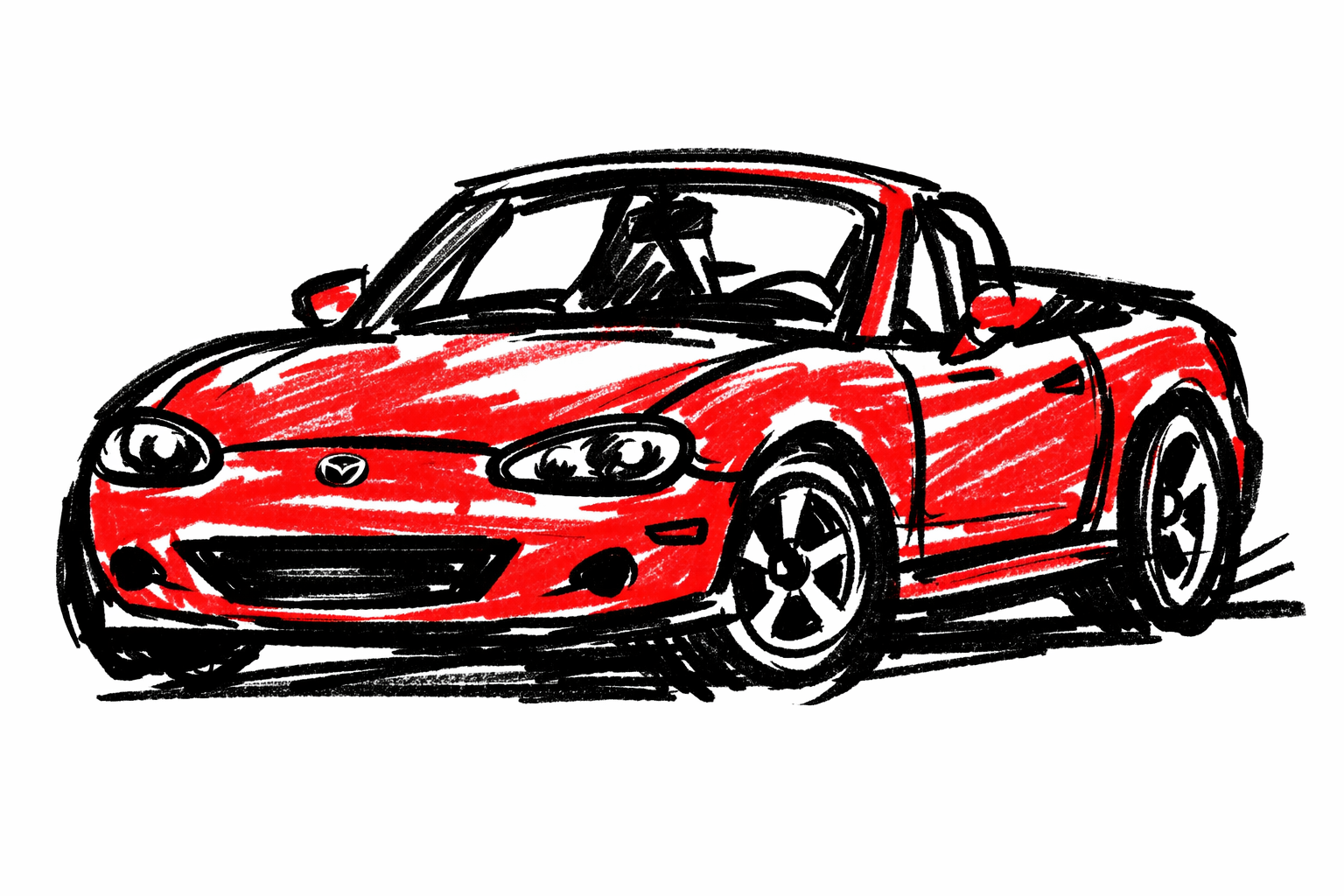
This guide is for Mazda MX-5 NB (1998-2005).
Fuse diagnosis is simple when you test methodically. Replacing random fuses without identifying failure condition often hides wiring/component faults.
- Ignition OFF before pulling/installing fuses.
- Replace only with same amp rating and same fuse format.
- Never bridge fuse contacts with wire/foil.
Required Tools
- Fuse puller (or insulated pliers)
- Flashlight
- Test light or multimeter
- Small assortment of correct blade fuses (7.5/10/15/20/30 A)
Where fuse boxes are on NB
Typical NB layout:
- Engine bay fuse/relay box near battery-side bay area
- Cabin fuse panel at lower driver-side dash/footwell area
Use your fuse-box lid legend first, then year/VIN documentation for exact assignment.
Step-by-Step Procedure
1) Define the failed function precisely
Write exact symptom before touching fuses:
- “left low beam out,”
- “blower works on 4 only,”
- “horn inoperative,” etc.
Precise symptom = faster circuit mapping.
2) Identify likely fuse from legend
Use cover legend/manual circuit list to find correct cavity.
NB variants can differ by market/options; confirm cavity name, not just approximate position.
3) Visual check (quick screen)
Pull suspect fuse and inspect metal bridge:
- intact bridge: not immediately failed,
- broken/blackened bridge: blown.
Visual checks miss hairline failures—always confirm electrically when possible.
4) In-circuit test-point method (best practice)
Most blade fuses have exposed test pads on top.
With circuit energized as appropriate:
- voltage on both pads -> fuse likely good,
- voltage on one pad only -> fuse blown,
- voltage on neither pad -> upstream supply/control issue.
This avoids pulling multiple fuses unnecessarily.
5) Replace with exact equivalent
Install replacement with:
- same amp rating,
- same physical blade type.
Color is backup only; printed amp number is final authority.
6) Re-test and observe failure timing
- If function returns and fuse survives repeated cycles: likely resolved.
- If fuse blows again, note when it blows (key-on, function activation, bumps, heat).
Failure timing is a strong diagnostic clue.
Quick repeat-blow fault isolation
- Blows immediately at key ON: likely hard short on feed/circuit.
- Blows only when specific switch used: likely failed load/device on that branch.
- Blows intermittently over bumps: likely harness chafe/loose terminal.
If repeat-blowing, stop replacing fuses and inspect wiring/load path.
Common mistakes to avoid
- Up-rating fuse (e.g., 15 A -> 20 A) to “make it stop blowing”.
- Mixing fuse sizes/types that fit poorly.
- Assuming relay/component is bad before proving fuse feed/output state.
Verification / Post-service checks
- Function operates normally across 2-3 cycles
- Fuse remains intact after short drive/vibration
- No burning smell or heat-discolored fuse/socket
Sources
- MELLENS — Mazda Miata factory service manual archive (NB fuse/circuit references by year). Retrieved 2026-03-14. https://www.mellens.net/mazda/
- 2CarPros — How to Check a Car Fuse (test-light method and replacement safety context). Retrieved 2026-03-14. https://www.2carpros.com/articles/how-to-check-a-car-fuse
- Wikipedia — Automotive fuse (blade fuse families and color-code background). Retrieved 2026-03-14. https://en.wikipedia.org/wiki/Automotive_fuse